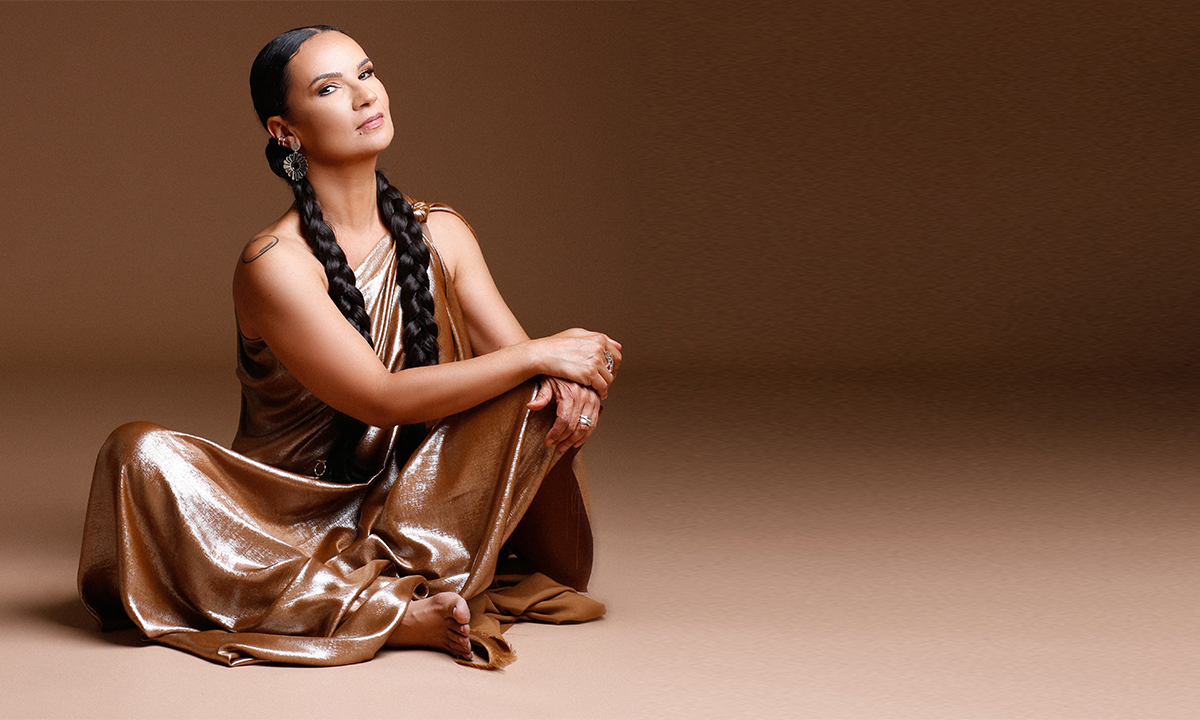
Dialddar: Oum’s Homecoming for the Soul
For over a decade, Oum has been the definitive voice of a modern, multi-faceted Morocco, blending ancestral roots with the contemporary rhythms of soul and jazz. With her latest project, Dialddar (Home Made), she pivots from the expansive landscapes of her previous works to the quiet sanctuary of the “inner home.” Here, she deconstructs the architecture of her new sound, a space where imperfection is embraced as truth and where Darija is whispered rather than projected.
To listen to Oum is to witness a master at work, not just as a songwriter, but as an architect of emotion. This dual identity is far from accidental; before becoming a global ambassador for Moroccan contemporary music, Oum El Ghaït Benessahraoui studied architecture in Rabat. That foundational training continues to shape her music today; not in the rigidity of blueprints, but in the way she constructs “rooms” of sound, light, and texture.
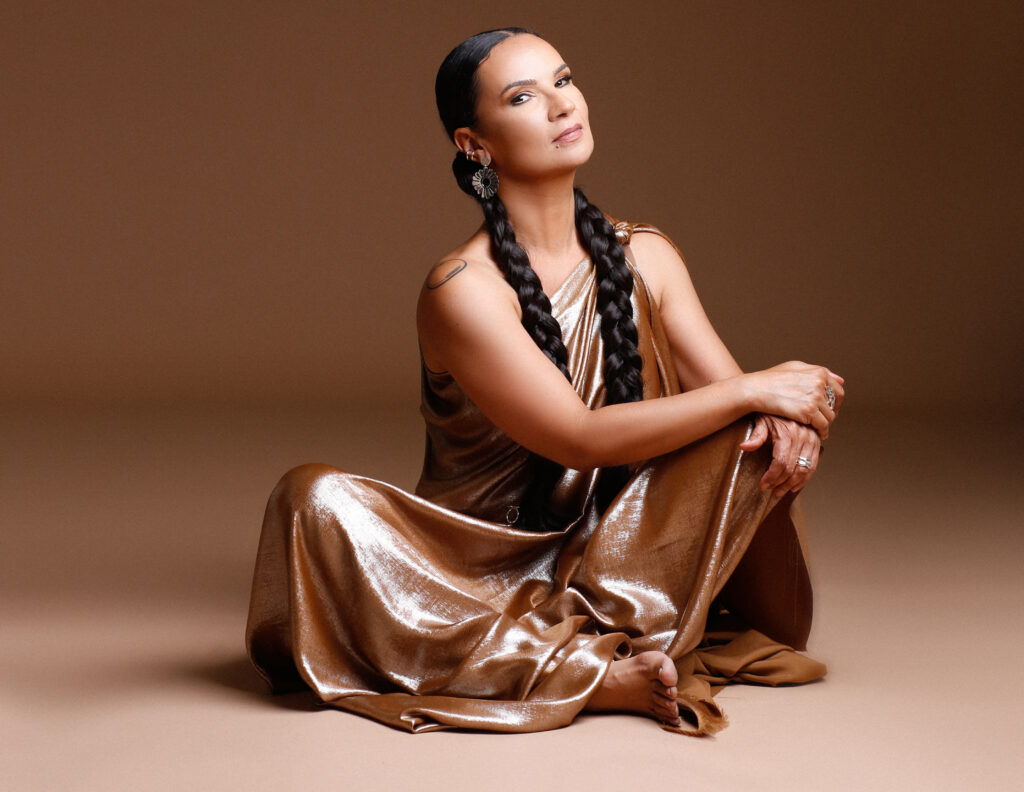
Oum photographed by Lamia Lahbabi
After years of touring the world and exploring the vastness of the Moroccan landscape in Zarabi, Oum’s latest evolution, Dialddar, feels like a homecoming. Yet, this isn’t a return to a physical address; it is a return to the self. Recorded with a deliberate “human touch” as a reaction to our increasingly polished, digital world, the album celebrates the cracks in the voice and the honesty of the breath. It is a “handmade” manifesto that proves Oum remains a real game changer precisely because she refuses to stay still. By bringing together collaborators like Kamilya Jubran and Yousra Mansour into her musical house, she has created a space of dialogue that feels as intimate as a secret, yet still carries a hypnotic, tribal pulse at its core.
This new chapter is set to be unveiled on stage, as Oum prepares for the highly anticipated launch of the album in Paris, May the 4th, at the Pan Piper, where the home she has built will finally open its doors to the public.
Osé Magazine : The title Dialddar (“Home Made”) suggests a return to roots or an interior space. After years of touring the world, what does “home” represent to you today, and why was now the right time to translate it into an album?
Oum : Today, home is no longer a place. It’s a feeling I carry with me.
Dialddar is that inner space. A place where I can exist without performing, without explaining. It felt like the right moment because I finally allowed myself to slow down and just be; and that’s where this album was born.
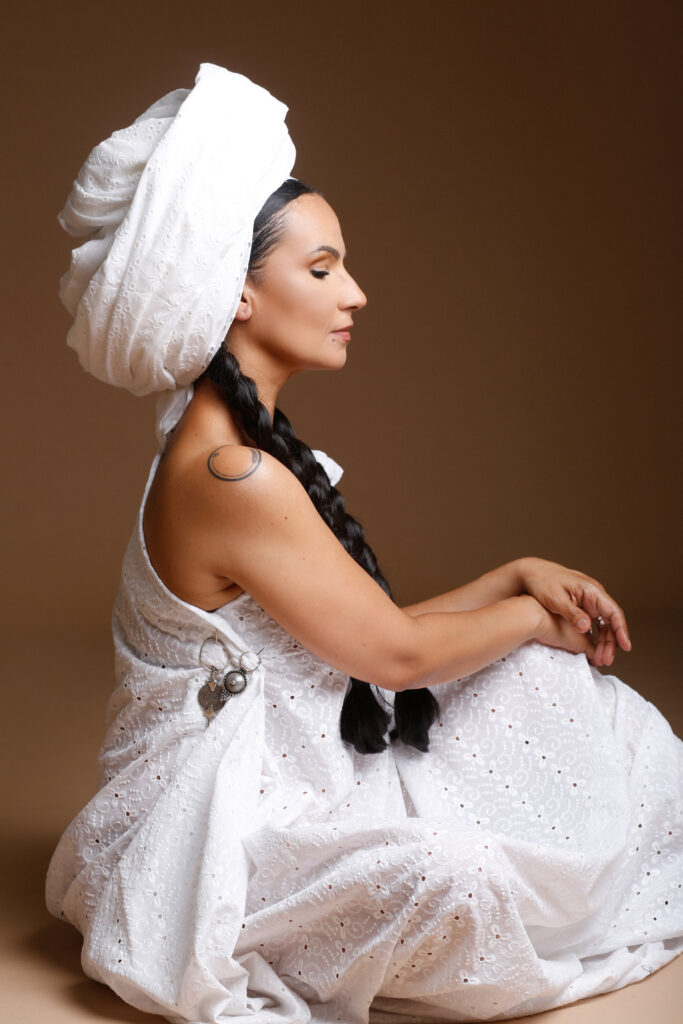
Oum photographed by Lamia Lahbabi
OM : You studied at the École Nationale d’Architecture in Rabat. When you were “building” this new album, did you find yourself using your architect’s eye to structure the songs, perhaps seeing them as rooms or structures rather than just melodies?
O: Definitely. I think of music the way I think of space.
Each track is like a room, with its own light, its own textures. There are invisible connections between them, like corridors or openings. I didn’t want a linear experience, but something you wander through, like discovering a house, slowly.
OM : You are a pioneer in making Darija sound soulful and contemporary. How did you push the boundaries of the language in Dialddar compared to your previous works?
O : Darija is alive, it evolves with us. In Dialddar, I want it to feel more intimate, almost whispered at times.
I allowed myself to be softer, more vulnerable. Less about projecting, more about revealing. It’s a Darija that doesn’t try to impress. It just wants to reach you.
OM : The title implies something artisanal. In an era of digital perfection and AI-generated music, how did you ensure that the “human touch” and the imperfections of a “home-made” project remained at the heart of the recording?
O : It is almost a reaction to that.
Everything feels so polished today, so controlled. I wanted to keep the breath, the cracks, the moments where the voice shakes a little. We kept imperfect takes because they felt honest.
Dialddar is not about perfection. it’s about presence. About truth.
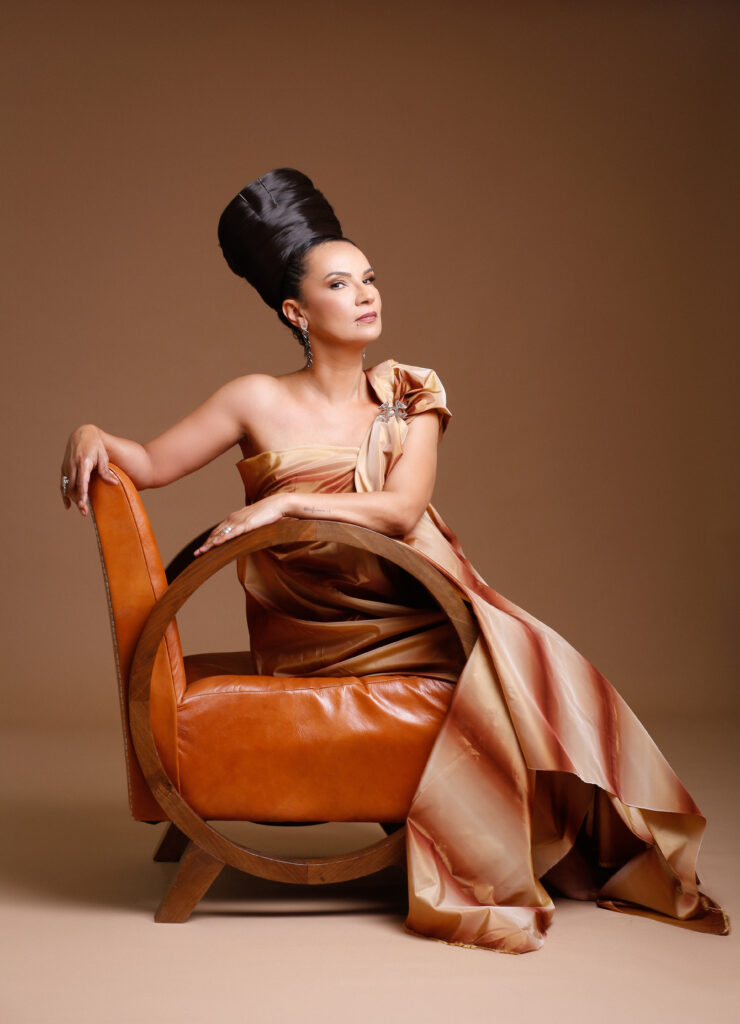
Oum photographed by Lamia Lahbabi
OM : The tracklist features interesting collaborations, such as with Kamilya Jubran and Yousra Mansour. How do these voices help tell the story of “Dialddar,” and what do they bring to your musical world?
O : They each carry a different emotional memory.
Kamilya has something deeply rooted. Beyond singing on the closing of FLSTYN, she was there throughout the entire creative process. Just like a third ear. A very intuitive, very precise presence. She listens beyond sound and gives a precious advice.
Yousra brings a different kind of freedom, something lighter, more instinctive.
Together, we turn Dialddar into a space of dialogue. A home that’s alive, not fixed.
OM : Your previous work (Zarabi) was deeply tied to the dunes of M’Hamid El Ghizlane. Is Dialddar an urban contrast to that, or is there still a piece of the desert inside the “home” you’ve created here?
O : You can hear it in certain rhythms, like in “MNINE” , an almost hypnotic tribal pulse that comes from the desert.
At the same time, there’s a more contemporary approach in the composition and arrangements of some tracks like “LACH” or “CHOOQ”. Maybe that’s where something more urban appears.
So it’s not a contrast. It’s more like a coexistence.
OM : As an artist who often pays tribute to Moroccan women (like the weavers of Taragalte), how does Dialddar explore the domestic or private lives of women in Morocco today?
O : The home, in our culture, is often a feminine space, but also an invisible one.
With Dialddar, I want to give presence to those quiet lives, those gestures, those inner worlds we don’t always see. It’s a tribute, but also a statement: these spaces hold stories, and those stories matter.
OM : We hear influences ranging from soul to Gnawa and Hassani in your work. In this new album, did you explore any new musical territories or instruments that you hadn’t dared to use before?
O : I explored new textures, but also silence. What happens between sounds. That becomes important to me.
At the same time, I reconnected with certain roots in a very intuitive way: Melhoun in “Awan”, taqtouka jabalya and tqitiqat in “Anawyyak”, and even the Daqqa of Marrakech in “A.B.”.
It’s not about mixing genres. It’s about letting them coexist naturally, like layers of memory.
OM : How do you plan to transpose the intimacy of a “home-made” album onto the large festival stages where you usually perform? Will the scenography reflect a domestic space?
O : I’m not trying to recreate a literal home, but rather a feeling.
Through light, textures, proximity… I want to create a kind of bubble, even in large festivals. Something almost intimate, like inviting thousands of people into the same emotional room.
OM : Many Moroccans living abroad find a sense of “home” in your music. What do you hope they feel when they listen to Dialddar while being far away from Moroccan soil?
O : Something soft. Something familiar.
Not nostalgia, but connection.
And I love the idea that Moroccans from all over the world can find, through this album, the right setting, un écrin, to celebrate our culture together, in communion.
Dialddar is not a place you return to.
It’s a place you carry.