
Tunu Kibelloh: The Vintage Archive Architect
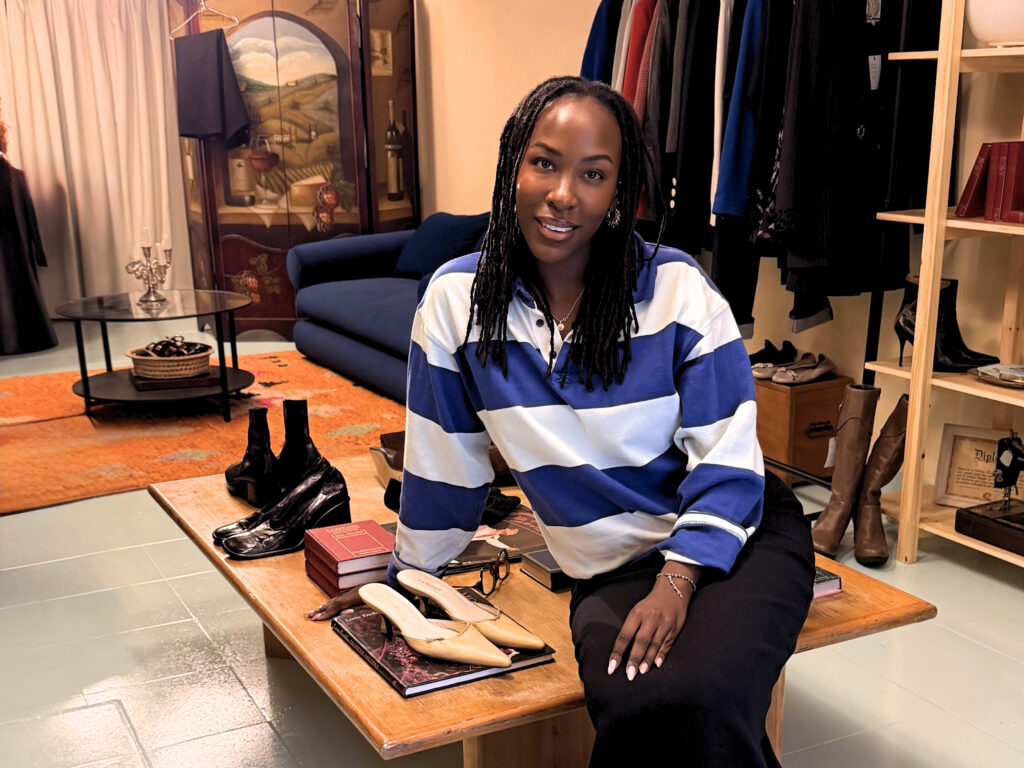
At a time when the fashion industry faces an unprecedented environmental crisis, Tunu Kibelloh proves that the most modern way to dress is to look backward. Founder of Le Vintage Village, she has transitioned from consulting to opening Ruhu, a “treasure trove” in Casablanca. Here, she discusses her multicultural upbringing, the “gap” in the Moroccan market, and why the tactile experience of a physical showroom is the ultimate sensory rebellion against mass-market consumption.
To understand the vision behind Le Vintage Village, one must trace the steps of its founder, Tunu Kibelloh. Born in Stockholm and raised across the vibrant landscapes of Dar es Salaam, London, and Paris, Tunu’s aesthetic was forged in the thrift stores and car boot sales of Europe’s fashion capitals. It was here, under the guidance of her mother and sisters, that she learned to read the “language” of a garment, not just its label, but the integrity of its stitching and the history of its fabric. Despite a Master’s degree in Political Science and a start in consulting, the pull of creative storytelling proved too strong. After graduating from Al Akhawayn University, Tunu made a definitive choice to stay in Morocco, handing her luggage to her parents at graduation to begin a new chapter in Casablanca.
This leap of faith allowed her to spot a profound opportunity: the chance to make vintage cool (or cooler) in a market increasingly dominated by the high-speed, low-quality cycles of mass retail. Tunu’s career pivot in 2018 wasn’t just a business move; it was a response to an industry in freefall. Today, the environmental cost of the new is staggering: the fashion industry is responsible for 10% of global carbon emissions and uses enough water to fill 32 million Olympic-sized swimming pools every year. With nearly 85% of all textiles ending up in landfills, where synthetic fibers can take 200 years to decompose, Tunu’s mission is a vital intervention. By launching Le Vintage Village and her new showroom, Ruhu, she creates a space where both Millennials and Gen Z can reconnect with quality. For her, vintage isn’t just about old and worn clothes; it’s about the radical act of choosing a piece that carries a soul, countering a global crisis that squanders the equivalent of one garbage truck of clothes every single second.
Osé Magazine: First of all, what would your definition of vintage and thrifting be?
Tunu Kibelloh: Vintage items are clothing, accessories, or textiles, that are at least 20 years old and reflect the styles, materials, and craftsmanship of their era. The construction, material, design, or cultural significance makes them collectible. The focus is on timeless quality, unique design, and historical relevance.
Thrifting is pre-owned clothing, accessories, or home goods regardless of age for the purpose of purchase, reuse, or resale. Thrifting is broader than vintage; it can include modern second-hand items, mass-market goods, or even contemporary fast fashion, as long as they’re sourced second-hand.
OM: Do you remember the very first vintage piece you ever bought or inherited? What was it, and do you still have it?
TK: I am sure there are many but the one I remember was a vintage levi’s denim jacket that my mum bought for me from a weekend market in Montreuil, Paris. I still have it and I have worn it to shreds even though I can no longer fit into it.
“I’ve seen a big shift in perception vintage used to carry a stigma as something “old” or “used,” but now people embrace it.”
OM : How have you seen the Moroccan appetite for “pre-loved” luxury change from when you first arrived to the opening of this showroom?
TK: I’ve seen a big shift in perception vintage used to carry a stigma as something “old” or “used,” but now people embrace it. They’re starting to recognize the true value of vintage, and how some pieces can hold more worth and uniqueness than brand-new items.
OM : You are a vocal advocate for the circular economy. How do you balance the “glamour” of luxury vintage with the seriousness of ethical consumption?
TK : Vintage isn’t just about glamour it’s also about quality, longevity, and craft. When you buy a vintage wool blazer from the 90s, you’re choosing an item that was made to last, reducing the need for new production, and honoring the labor and materials that went into it. Vintage pieces become vehicles for conscious consumption, not just indulgence.
OM : When sourcing for the showroom, are you looking for specific big houses labels, or are you more interested in the architectural silhouette and quality of the fabric?
TK : I’m interested in the silhouette, quality of the fabric and cultural significance I source pieces that evoke memories, nostalgia, or a connection to an era.
OM : What is the most difficult aspect of managing a vintage supply chain (in Morocco and or elsewhere)? Logistics, sourcing, or “educating” the consumer?
TK : The biggest challenge of running a vintage shop in Morocco isn’t logistics it’s helping customers understand the true value of what they’re buying. Many assume that because a piece is old it should be cheap, but as time passes, it’s increasingly rare to find 100% wool blazers or 100% silk blouses in stores almost everything now is polyester. Vintage prices reflect not just age, but the time, effort, and care required to source and preserve these pieces, as well as the superior quality of fabrics and construction.
“Curated by Tunu is chic, elegant 90s nostalgia.”
OM : If someone were to look at a rack of clothes, how would they know a piece was “curated by Tunu”?
TK : Curated by Tunu is chic, elegant 90s nostalgia. Think effortless yet structured: a well-cut blazer over a simple white cotton tee or silk blouse, layered with 90s denim or paired with a long pencil skirt and early 2000s pointy-tip heels. It’s all about pieces that feel polished without trying too hard.
OM : What are your own favorite thrifting spots in Morocco and around the world?
TK : I grew up in North London and honestly, some of my best pieces were sourced from charity shops in Highgate, Hamsptead and Muswellhill. If you’re willing to wake up early and hunt then Montreuil weekend Market in Paris has some gems also Souk Sebt in Casablanca
OM : What do you think of people criticizing other making businesses of vintage, like they are “preventing” someone in need to get the affordable piece from the flea market?
TK : I would say there there’s truly something for everyone. Buying from flea markets doesn’t “take away” from the other, scarcity only exists if we think there isn’t enough. In reality, the market is very big and it’s only getting bigger.
OM : About le Vintage Village, do you have a next edition date? Will it be moving in Morocco soon?
TK : The next vintage date will be in May. Follow us on Instagram @le.vintage.village to not miss the date announcement. Taking it to other cities is the dream.