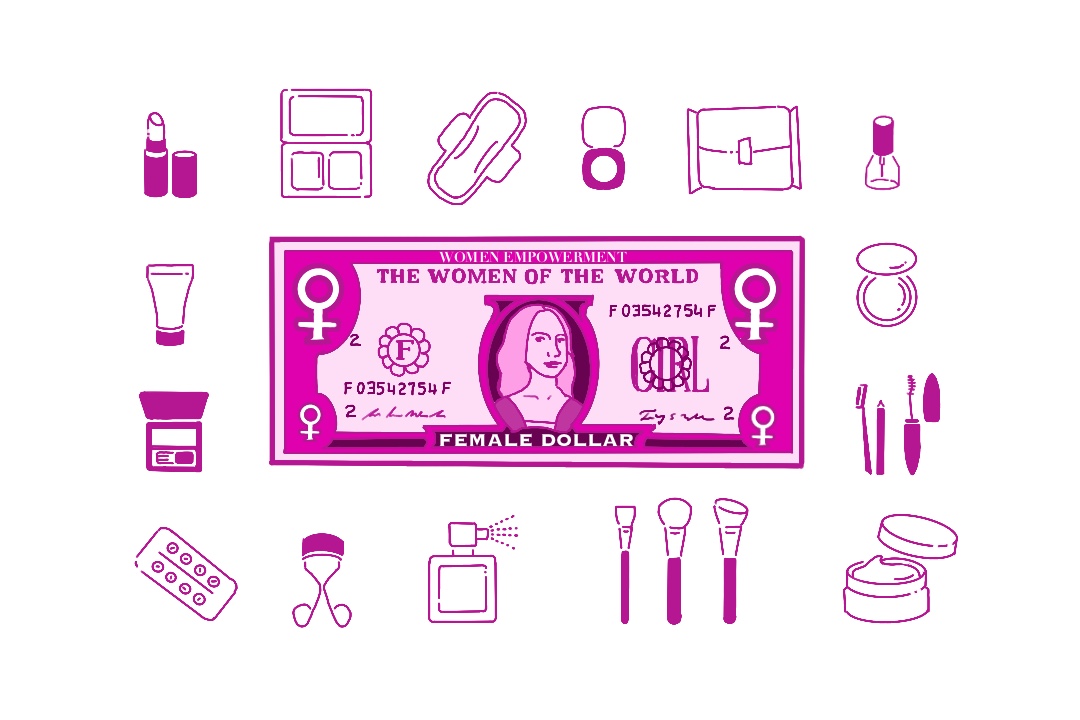
The Hidden Cost of Pink: Unmasking the Global Pink Tax
For decades, a silent surcharge has been applied to the shopping baskets of half the global population. Whether it’s a pink razor in a Parisian pharmacy or a girl’s school uniform in London, the “Pink Tax” remains a persistent economic reality. While manufacturers often point to “design differences”, studies consistently show that women pay more for products that are functionally identical to those sold to men.
The Salary Gap: A “Negative” Pink Tax
Let’s start on a “Hello Captain Obvious” note. While the Pink Tax refers to spending more, the global gender pay gap functions as a “tax” on time and talent. On average, women globally earn roughly 80% of what men earn, a 20% gap that remains one of the most persistent economic hurdles. In many regions, this isn’t just a matter of different job choices; even when controlling for industry and experience, women often face a “wage equality gap” of roughly 5% to 10% for identical work/experience.
The Razor Disparity: Paying More for Less
The razor aisle is perhaps the most famous example of the Pink Tax, but the discrimination goes deeper than just a higher price tag. Research into razor packaging reveals a “double hit” for women: Price Per Unit: Women’s 4-blade and 5-blade razors are consistently priced between 45% and 66% higher than men’s versions with the same number of blades. The Pack Count Trap: Manufacturers often use “shrinkflation” tactics specifically on women’s products. A pack of men’s disposable razors will frequently contain 10 to 12 units, while the pink version next to it contains only 8 units for a higher total price. When you calculate the “cost per shave”, women are often paying nearly double for the same stainless steel edge.
The “Toilet Paper” Argument: A Biological Double Standard
A viral statement on social media has recently reframed the Pink Tax as a matter of basic human rights: “Toilet paper is free in public toilets because men need it too”. Let that sink in. This argument highlights a stark biological double standard in public infrastructure. We have collectively decided that “bathroom tissue” is a fundamental necessity that must be provided free of charge in every stall. However, menstrual products, – which are just as essential for managing a natural bodily function-, are almost universally hidden behind coin-operated dispensers or absent entirely. By making toilet paper free but charging for pads, society essentially “taxes” a biological process that only half the population experiences.
From the Nursery: Starting the Gap Early
The price disparity begins long before a woman earns her first paycheck. In the toy aisle, products marketed to girls, often featuring “pinkwashing” or floral patterns, cost an average of 7% more than the “blue” or neutral versions. This gap is even more pronounced in children’s clothing; a girl’s basic cotton shirt can cost up to 12% more than a boy’s, even when the fabric and manufacturing labor are nearly identical.
The Service Surcharge
The Pink Tax extends beyond the shelf and into the service industry. Dry cleaning is a prime example: a woman’s plain cotton blouse can cost 50% more to clean than a man’s button-down shirt, with cleaners often citing the “delicacy” of the garment or the size of their pressing machines. Similarly, women with short hair are frequently charged significantly more for a trim than men with the exact same hair length, a practice that is only recently being challenged by new legislation in some regions.
An Accumulated Lifetime Burden
While a few extra cents on a razor or a few dollars on a haircut may seem negligible in isolation, the cumulative effect is staggering. Estimates suggest that the Pink Tax costs the average woman approximately $1,300 to $1,400 USD per year (or the equivalent in their local currency). Over a lifetime, this gender-based pricing gap, combined with the global gender pay gap, creates a significant financial hurdle for women’s long-term economic stability.
The Financial Services Surcharge
Recent financial studies have uncovered a “Pink Tax” in the banking sector. Despite often having better credit repayment histories, single women frequently pay higher mortgage interest rates and loan fees than single men. In some markets, women pay up to 16% more in net loan costs. This disparity is often attributed to “statistical discrimination”, where lenders or algorithms may inadvertently penalize women based on social norms or perceived financial sophistication, even when their objective risk is lower.
The “Motherhood Penalty” vs. “Fatherhood Bonus“
The economic landscape shifts even more dramatically when children enter the picture. Women often face a “motherhood penalty”, seeing their earnings drop by 4% to 7% per child. Conversely, studies show that men often receive a “fatherhood bonus”, with their perceived reliability increasing, leading to average salary bumps. This cultural tax on caregiving further depletes the financial reservoir women use to navigate an already more expensive marketplace.
Automotive & Technical “Information Surcharge“
The Pink Tax also thrives on perceived lack of information. In the automotive industry, undercover studies have shown that women who appear “uninformed” about market prices are quoted repair costs up to 20% higher than men in the same position. It is only when women explicitly mention a benchmark price that this gap disappears, proving that a “gender premium” is often built into the initial quote by service providers.
April 20, 2026
Farah Nadifi
Why being a female consumer costs more from the cradle to the cane.
Discover the Exhibit
Our celebration of young and incredibly talented Chinese artists. Their artworks will be available for viewing all throughout the spring season as we usher in the New Year.
The Year of the Fire Horse


Xie Shiyi
03
DANLI MA
02
Huang Wang
01
Li xueer
04
CHENJIAN BOWEN
05
Yu Liu & Lief
06
Bella
07
ZHANGZHIWEI
08
Li Zihong
09
Discover the Artists
Osé Digital Art Gallery
Enjoy our Spring Feature Exhibition
Have a story to tell? We'd love to hear it. Let’s begin with a simple note.
And everywhere in between
Paris to Casablanca
@2030 copyrighted | Osé OmniMedia SAS
Based in Paris & CASablanca
| Available worldwide
hello@theosemagazine.com