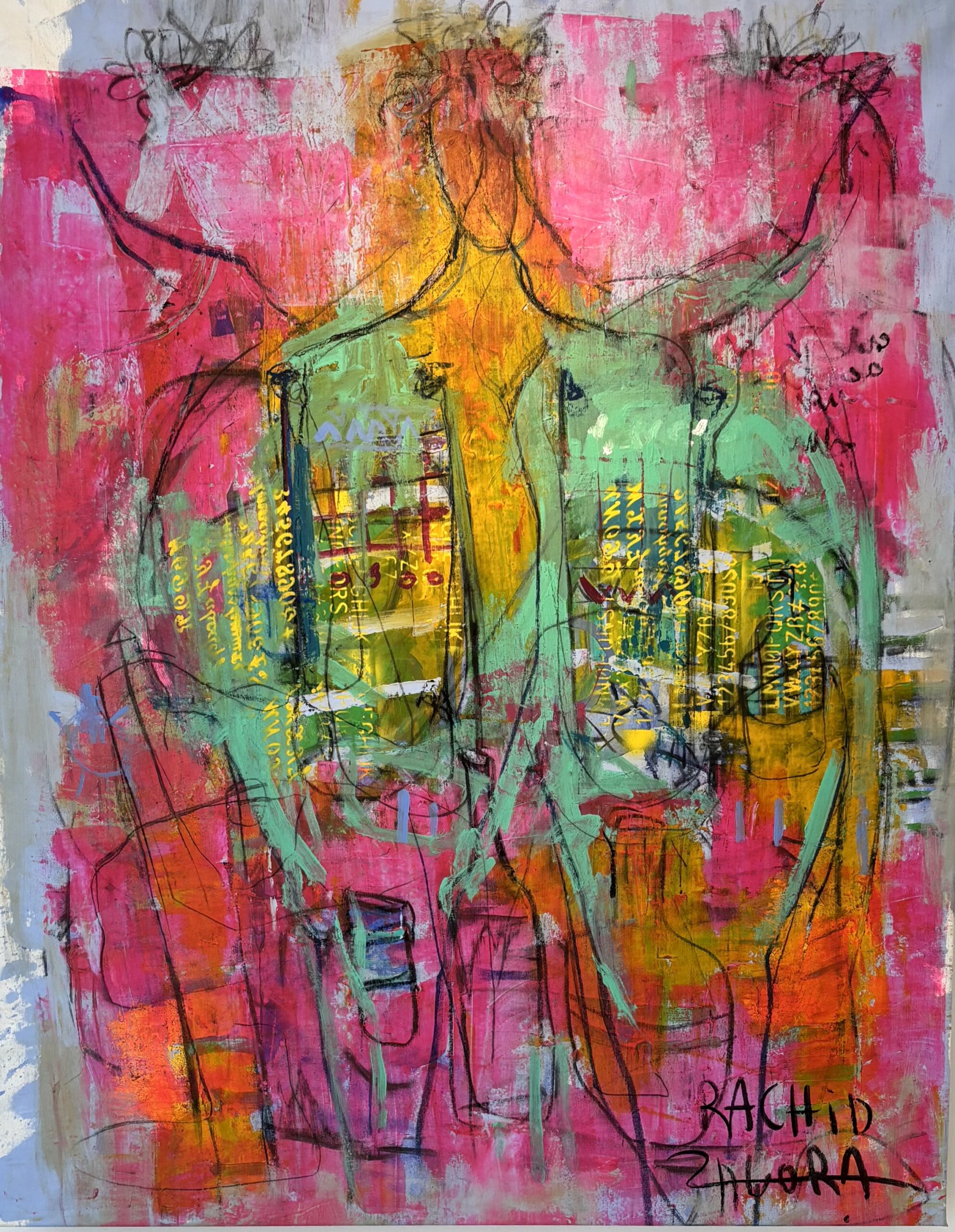
Rachid Zagora: Color, Love and Connection
Meeting Rachid Rafik is like stepping into a party you never knew you wanted to be invited to but you can’t help but stay and dance. I was first introduced to Rachid’s work when I was exploring outside of Marrakech and just happened upon his artist’s residency, Dar Zagora.
The artist in question wasn’t even in the building but his essence and a gigantic, colorful and lively 2m x 3m painting of a donkey was. After years of exchange, we finally had the occasion to meet at a show he was holding here in Paris. His art filled the white gallery walls with color and he, along with his art breathed a breath of life into an otherwise lifeless space.
Rachid Rafik or Rachid Zagora, as he is known, is a reflection of his work (or it’s possible his work is a reflection of him), bright, colorful, energetic and inviting. At the end of his exhibition in the heart of St. Germain des Près, he popped open some champagne, buzzing around the room as people came and went. His ability to connect and his clarity of self and his artwork is unmatched in a world that struggles to hold our attention span. We clinked glasses of the champagne he insisted I drink with him, “santé” he said as he disappeared to serve the others. He was simultaneously on 25, as he floated around the room to interact with guests and potential buyers and on 2, as he sat focused, engaged and indulged my curiosity about his life, his artwork and Dar Zagora.

Osé Magazine: So tell us, what’s Rachid’s story?
Rachid Zagora: Hello, I’m Rachid, nice to meet you (he says jokingly). Rachid Zagora, because I come from Zagora. For the first part of my life, until I was about fifteen, maybe even twenty, I lived in Zagora. It’s the desert, it was just sand. To get water, you had to walk three kilometers and to study at night, you used a candle. It was simple. I had my father, like everyone else. For me, [going to school] was a passport out of the desert, towards the city. And the city at that time Marrakech, when I was twenty. There I studied economics but I never stopped painting. I was a bit political at the time, so I drew for all the demonstrations. After that I went to Casablanca to study at the Fine Arts school. Then I taught for a year. That’s how, around 2000, my professional career began.
OM: What are some of your earliest memories with art and being influenced by it?
RZ: When I was twelve, a French woman came to live in Zagora because she had rheumatism. She was a catholic nun. We crossed paths and she suggested I take a painting class and now forty years later here I am. I never knew I would become the Rachid I am today but I never let it go. Painting is like an addiction to me. Really, it’s something else. I always find an excuse to draw. I draw easily, I give it to everyone. It’s a pleasure in cafés and everywhere else. That’s how my ideas for painting began.
And my first exhibition was at school. Back then the first painting I sold was for 20 euros, (200 dirhams at the time). Twenty euros back then felt like 20,000 euros now. It was something new and exciting.
OM: When did you create Dar Zagora and what does it mean to you? Can you tell us a bit about your home?
RZ: After running around in the first chapter of my life, in 2012 I created Dar Zagora, my atelier. It was my dream since I was a child to create a place like that. As a tribute to Marie-France (the nun), who taught me how to paint. For ten years she gave me lessons for free, even materials and every time I asked her why, she told me, “it’s for pleasure and when you can, do the same.”
“For ten years she gave me lessons for free, even materials and every time I asked her why, she told me, “it’s for pleasure and when you can, do the same.” “
That’s why Dar Zagora exists. You know Dar Zagora, you’ve visited it, it’s everyone’s home. It has changed now, but there are always people there. All artists are welcome: the door is open to them. It’s my way to help.
OM: Can you share a bit of your creative process and artistic philosophy?
RZ: I always dare [ose] to do what many artists don’t, because they want the buyer. I create art for myself. I am a bit relentless when I’m in front of the work. It is work, after all. You really have to give yourself fully to reach that moment of being with or sharing that moment with others. It doesn’t happen just like that. It can come in a flash, but there’s all the work to begin it, to create that charm and pleasure. That’s where you can really respect the pleasure behind it. That’s my mindset. I work with the word osé. An artist who doesn’t dare? For me, that’s not really an artist. I’m not an artist of demons. I dare, I take pleasure in it, going all in so that everything inside is opened up and expressed.
I am not a philosophical artist. You see the catalog, there’s beautifully written text but I am Rachid and first of all I am pleasure. I am not the artist who poses. I make art without thinking, I don’t stroke the work, I don’t stare at it, I don’t put on an apron in the morning and say “Okay I am going to paint.” I don’t ever know what I am going to paint. There is the animal inside us that we hide, we only show it when we are closed off, when we want to see it but that animal exists and we must respect it.

OM: Throughout your art what has inspired you?
RZ: It’s spontaneity. Spontaneity and Africa. The other person’s energy speaks to me. You can be here with me and I can make you a painting because that energy speaks to me. The energy gives me this value, this feeling. You know this feeling when you’re already in love and you feel like you can jump over three walls and you don’t even know why. That’s the energy for me, that’s what painting is.
I succeed, here or elsewhere because of showing the side [of me] I want to share with others.
OM: So what do you want to share with others?
RZ: Joy and daring.
Dare to take away the pressure of having a thousand friends. Dare to be solitary. Do it for yourself. That’s the joy.
OM: You mentioned you work spontaneously, does that mean you paint everyday?
RZ: Every day, every hour, every moment for me is work, but not work. It’s a pleasure. I don’t work, work is for others. I take pleasure because if I feel like I am working I can’t do it. People ask me to make paintings, but I can never do it because then it becomes work.
OM: How do you manage to bring everyone here to you? Is it through connection?
RZ: With love. Love can erase everything. If we have that inside and share it, it means we are present for the other. The galleries may not know me, they came for my work because I give off a kind of light of love and [even if] I’m not there, you can see it. When you work with love, you receive love. When you do things for others, inshallah, one piece is for yourself and two are for the other [person].
OM: You have a real community around you.

RZ: I always say it’s energy. You have the same thing too, I can see it. I was connected with you before I even saw you. I didn’t know you at all and I was even looking for you and I had all kinds of thoughts in my head. I wasn’t even there, I didn’t even know you but you’re energy called me. Then here you are, arriving on your bicycle and now I see you differently. It’s destiny and you always have to be present. It’s the person, the light, the energy you give off, you can see it from far away. I don’t know you but it crosses over, it gathers there.
OM: You have created the concept of the nomadic artist. Where does that come from?
RZ: The nomadic artist started during Covid. I came to France for performances with magicians and I got stuck here. The first three months we couldn’t move. Then they let us go 100 kilometers so I set up my studio and started moving around. I worked hard, sold paintings, bought a car and toured France delivering my work. That’s when the launch of the nomadic artist idea started. I can turn your apartment into a studio residency and invite everyone to come paint.
Dar Zagora is a bit like that as well. Everyone comes and goes.
“Love can erase everything. If we have that inside and share it, it means we are present for the other.”
OM: Speaking again of Dar Zagora, I wanted to ask: What’s the special touch? Why does it feel like when you walk through the door you’ve entered into another world?
RZ: It’s the energy of the place and it’s not just me. Everyone says it’s the energy, it’s your energy because you came in and left your energy, then the next person and the next person. Even when we’re not there, we’re there. You are never alone there, it radiates because of everyone around you who brings that energy, the beautiful thing is us, it’s us giving it that value.
OM: There’s an author, Elizabeth Gilbert, who talks about the idea that we all have a genie that is inside of you and that’s what comes out in any creative endeavour. Do you have a theory like that or is there another way you access your creativity?
RZ: It’s not God for me. But it’s the energy between each of us. If you accept yourself, if you know the book The Secret, and believe in things it becomes easy. You are what you are but you have to accept it. If you accept it, it works. In contact with yourself. Love, flaws, if you accept it you’re happy. You can’t change anything in life but you can accept it, live well and pass it on to the next generation.


OM: We’ve talked about daring throughout this interview. What’s the boldest, most audacious thing you’ve done?
RZ: What I am doing right now. Daring to be an artist, daring to be Rachid, daring to be myself, daring to have a child for pleasure, daring to say what I want, daring to change my life beyond my culture. I remain Moroccan in culture but in my head, I dared to go beyond what I lived there.
OM: In this world, we have so much technology changing everything. How do you think it will change art?
RZ: In my opinion, many people have changed because they find things easily, like ChatGPT. You can make your painting [with it], you ask it and it writes a text for you but the soul that remains the soul. The soul is essential for art. It allows us the right to error, to excitement, to jealousy.
OM: What legacy would you like to leave behind? What would you like to leave in the world before you go?
RZ: Love, love, love, if I can do that. You know, we go through hard times because we have become robotic in the head and in our lives but the only thing that can save us is love. That’s the power of love, touching other people. If we become robotic everyone becomes the same. But when you love, you become blind and you only want good for life.
Discover the Exhibit
Consciousness is a state of awareness that exists in all of us.
Through this exhibition, we explore consciousness through the lens of four incredibly talented artists. They offer a global perspective shift in consciousness and how through different cultural lenses the idea of consciousness changes.
Whether it is captured through the eyes of another, in contemplation, within the evolution of self or in stillness, they all truly capture that inner knowing that lives inside of us all.
Consciousness


Javier garcía sánchez
03
Klazicmoskoart
02
Kknairuti
01
munyange
04
Discover the Artists
Osé Presents
Have a story to tell? We'd love to hear it. Let’s begin with a simple note.
And everywhere in between
Paris, san Francisco, Casablanca